


B&W Copiers > KM-3050
Kyocera Mita KM-3050
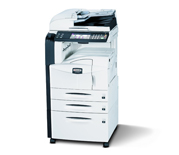 The KM-3050 is an extremely reliable multifunctional that is above all easy to use. Kyocera system software allows several tasks to be carried out simultaneously - enhancing cross-network co-ordination, reducing downtime and improving the efficiency of the whole workgroup. Simple to operate, it takes your document handling capabilities to a new level.
- 30ppm A4 / 20ppm A3 departmental multifunctional
- Easy-to-use combined printer, copier, scanner, with optional fax
- Colour wide touch panel with adjustable tilt
- Duplex as standard
- First copy 3.9 seconds or less
- Maximum paper capacity 4,200 sheets
- Long-life components for outstanding reliability
View/Download Product Brochure
Specifications
General
Technology
Kyocera ECOSYS, Laser
Engine speed
Max. 30/20 pages per minute A4/A3
Resolution
600 x 600 dpi (copy), 1,800 dpi level x 600 dpi (copy, photo mode), 1200 dpi quality (print)
Warm-up time
30 seconds or less from power on
Time to first copy
3.9 seconds or less
Dimensions
Main unit: 599 x 646 x 745 mm
Weight
Main unit: Approx. 85 kg
Power consumption
Printing: 1010 W, Stand-by: 230 W, Power-Saving (ECOpower): 17 W
Power source
AC 220 ~ 240 V, 50/60 Hz
Noise (ISO 7779)
Printing: 69 dB(A), Stand-by: 52 dB(A), Power-Saving (ECOpower): Immeasurably low
Certifications
TÜV/GS, CE, ISO 15408
Paper Handling
Input capacity
2 x 500-sheet universal paper feeder, 60-105 g/m², A3-A5R, Folio 200-sheet multi-purpose tray, 45-200 g/m², A3-A6R, Folio, envelopes. Max. input capacity with options: 4,200 sheets Duplex as standard supports A3-A5, 60-80 g/m².
Output capacity
250 sheets face-down
Further information All paper capacities quoted are based on a paper thickness of max. 0.11 mm. Please use paper recommended by Kyocera under normal environmental conditions.
Processor
PowerPC 750FL / 600 MHz
Memory
Standard 512 MB (max. 1 GB), 80 GB HDD
Emulations
PCL6 incl. PJL, KPDL 3 (PostScript 3 compatible) Line Printer, IBM Proprinter X24E, Epson LQ-850, Diablo 630
Fonts
80 outline fonts (PCL6), 136 PostScript KPDL 3 fonts, 1 bitmap font, 45 types of one-dimensional barcodes plus two-dimensional barcode (PDF-417), Downloadable fonts: Kyocera, PCL + TrueType format, Type 1 + 3 format
Features
EMPS - for quick copy, Proof and hold, Private print, Job storage, Job management functionality
Copy
Max. original size
A3
Digital features
Interrupt output job, scan once print many, electronic sort, rotate sort, rotate copy, N-up copy, split copy, cover mode, page numbering, box image overlay, margin shift, border erase
Exposure modes
Auto, manual: 7 or 13 steps
Zoom
25-400% in 1% steps (with DP-700: 25-200%)
Continuous copy
1-999
Memory capacity
Standard 512 MB (max. 1 GB) + 80 GB HDD
Scan
Bundled scan-software
KM-NET Viewer, TWAIN source, PaperPort Delux 9.0
Interfaces
10Base-T/100Base-TX
Compression format
B/W: G4 (MMR) Colour: JPG
Original recognition
Text, photo, text + photo, OCR
Max. scan size
A3
Scan functionalities
Scan-to-SMB FTP, Scan-to-email, Scan-to-BOX, BOX TWAIN, Network TWAIN
Scan resolution
600, 400, 300, 200, 200x100, 200x400, 256 greyscales, 256 colour: Colour scanning at resolutions of 400 dpi and above requires additional memory.
Scan speed Max.
50 originals per minute in b/w (600 dpi/A4), 25 originals per minute in colour (600 dpi/A4)
Fax
Compatibility
ITU-T Super G3
Modem speed
Max. 33.6 kbps
Transmission speed
3 seconds or less (JBIG)
Scanning density
Normal: 8 dot/mm x 3.85 line/mm, Fine: 8 dot/mm x 7.7 line/mm, Superfine: 8 dot/mm x 15.4 line/mm, Ultrafine: 16 dot/mm x 15.4 line/mm, SUFine: 600 x 600 dpi
Max. original size
A3
Compression method
JBIG, MMR, MR, MH
Memory
Standard 120 MB (enable fax image back up BU-10)
Fax features
Internet fax, Network fax, Rotate transmission, Confidential, Relay and bulletin board transmission and reception
Interfaces
Standard interface
High speed bi-directional parallel (IEEE 1284), USB 2.0 (Hi-Speed), USB Host Interface dedicated for USB Flash Memory device, Fast Ethernet 10-Base-T/100Base-TX, CF slot
Multiple interface connection (MIC)
Allows simultaneous data transfer via up to four interfaces, with each interface having its own virtual printer.
